|
|
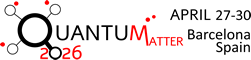
The 6th edition of the Quantum Matter International Conference & Expo – QUANTUMatter2026 (Barcelona, Spain) – aims at gathering the various communities engaged in the science and technologies of quantum information and quantum matter, to foster the incubation of new ideas & collaborations at the forefront of quantum technologies, emerging quantum materials and novel generations of quantum communication protocols, quantum sensing and quantum simulation.
|
|
|
Quantum Information and Quantum Matter are two components of revolutionary treatments of information, which are becoming cornerstones for discovering and implementing disruptive paradigms in quantum computation and quantum technologies
|
|
|
|
|
|
 |
|
 |
The Phantoms Foundation is a Professional Conference Organiser specialised in the planning and execution of conferences and online meetings focused on Nanoscience & Nanotechnology and in particular "Graphene and 2DM". The Phantoms Foundation, a non-profit organisation, is a key actor in structuring and fostering European Excellence and enhancing collaborations in these fields, giving as well high level management profile to National and European scientific projects (Involved in 11 European projects in the last 10 years either as coordinator or partner) and providing an innovative platform for dissemination, transfer and transformation of basic nanoscience knowledge, strengthening interdisciplinary research in nanoscience and nanotechnology by catalysing collaboration among international research groups. |
| Currently, one of its main core activities is to organize International conferences, meetings and workshops in particular in the "Graphene and 2D Materials" area: |
| |
|
| |
 |
The Institut Catala de Nanociencia I Nanotecnologia (ICN2) is a flagship research institute within the CERCA network of centres created and supported by the Autonomous Government of Catalonia to raise Catalan science to the premier international level. The patrons of ICN2 are the Government of Catalonia (Generalitat), the Consejo Superior de Investigaciones Científicas (CSIC), and the Autonomous University of Barcelona (UAB). Its core activities are Frontier Basic and Applied Research in Nanoscience and Nanotechnology, Technology Transfer, and Public Outreach. Currently, ICN2 numbers some 200 staff from over 30 countries, of which about 170 are researchers. In addition to the theoretical and experimental groups involved in the project, ICN2´s activities in graphene include thermal management, photovoltaic, biosensors and energy applications, gathering about 40 researchers (permanent staff, postdoc and Ph.D. students). ICN2 achievements were recognised in 2014 with the Severo Ochoa Centre of Excellence accreditation, the most prestigious award targeting research centres in Spain.
|
| |
 |
Donostia International Physics Center (DIPC) is a research center that develops cutting-edge research in physics and related disciplines. DIPC's mission also includes the transmission of scientific culture to society, as well as responding to global societal challenges that demand scientific insight.
DIPC is singular in its institutional structure. It is a center funded and governed by both public institutions (Basque Government, University of the Basque Country UPV/EHU, Gipuzkoa Provincial Council, and San Sebastian City Council) and private companies (Kutxa Fundazioa, Fundación EDP, Telefónica and CAF). DIPC is also singular in the way it operates. It is a dynamic organization that follows flexible management rules. DIPC's philosophy is to promote an austere, simple and agile operation, far removed from bureaucratic rigidities, based on intellectual rigor, creativity and freedom.
DIPC counts on more than 200 researchers distributed across 4 scientific areas, namely QUANTUM, NANO, COSMOS, and LIFE. Scientific leaders are mostly hired through the competitive Basque Government's Ikerbasque Program. With a large community of visiting scientists, the center acts as a catalyst for knowledge in its close scientific ecosystem. It produces more than 450 scientific publications annually and it currently holds several active ERC grants.
|
| |
 |
The CSIC is the largest public research organisation in Spain and one of the most important in the European Research Area (ERA), as well as the main player in the Spanish Science, Technology and Innovation System (SECTI). Currently, the CSIC is formed by over 13,200 people, distributed between the CSIC Corporate Organisation and the 121 research institutes and three national centres, distributed throughout Spain, as well as an institute in Rome. The CSIC's research activity falls into three core areas, Society, Life and Materia, which cover the vast majority of academic disciplines.
|
| |
| |
| |
The CEA is a major research organisation working in the best interests of the French State, its economy and citizens. Thanks to its strong roots in fundamental research, it is able to provide tangible solutions to meet their needs in four key fields: Low-carbon energy (nuclear and renewable) / Digital technology / Technology for medicine of the future / Defence and national security
A multidisciplinary institution located in the heart of the French Alps, Université Grenoble Alpes (UGA) is renowned for its scientific and technological research activities, aimed at providing essential training to students and faculty and at addressing societal issues.
|
|
|
|
|
 |
|

|
|
Constructor Capital is a Swiss based early stage capital firm investing in Deep Tech, Software, and Edtech.
We bridge frontier research and scalable venture capital, backing founders who turn scientific breakthroughs and advance software ideas into global businesses. |
| |
|
|
 |
|
BasQ is an initiative led by the Department of Education of the Basque
Government in coordination with the Provincial Councils of Araba,
Bizkaia, and Gipuzkoa that has the ambition to position Euskadi as one
of the world´s leading quantum hubs by developing an ecosystem of
Research, Talent and Innovation in Quantum Technologies.
The commitment to Quantum Science and Technologies in the Basque Country
goes back several years with the launching of the Basque Excellence Research Centers (BERC) Program and, particularly, with the
establishment of the Donostia International Physics Center (DIPC) and the Materials Physics Center (MPC), along with initiatives and deliberate strategies thereafter.
It is in this context of quality and excellence-oriented science system,
and a fruitful public-private cooperative dynamic that Euskadi's commitment to Quantum Technologies emerges, a long-term commitment with a clear focus on science impact, as part of the IKUR Strategy |
| |
|
|
 |
|
Quantum Spain aims to promote and finance a competitive and complete quantum computing infrastructure in Spain. It will provide the present Spanish quantum ecosystem with the necessary tools to develop a solid scientific and technological fabric around quantum computing and its applications in Artificial Intelligence.
Quantum Spain is an initiative promoted by the Ministry of Economy through the Secretary of State for Digitization and Artificial Intelligence and financed with the Recovery Funds. |
| |
|
|
 |
|
As part of the quantum computing ecosystem that aims to create Quantum Spain, the TalentQ program focuses on the training and growth of talent. To this end, resources will be allocated for the organization of events such as seminars, schools, workshops and hackathons, the support of local initiatives and groups, and the creation of a support infrastructure with tutorials and other utilities that allow you to progress in quantum computing. |
|
| |
|
|
|
|
|
 |
|
 |
|
|
|
| |
|
|
|
|
|
 |
|
| |
| |
|
|
|
|
| |
 |
| |
| Organising Committee |
| Antonio Correia (Phantoms Foundation, Spain) - Chairperson |
| |
| Silvano de Franceschi (CEA/UGA, France) – Co Chairperson |
| Ricardo Díez Muiño (DIPC & Ikerbasque, Spain) |
| Juan Jose Garcia-Ripoll (IFF-CSIC, Spain) |
| Stephan Roche (ICREA / ICN2, Spain) |
| |
| Local Organising Committee |
| Jordi Arbiol (ICREA / ICN2, Spain) |
| Adrian Bachtold (ICFO, Spain) |
| Bruno Julia (UB, Spain) |
| John Calsamiglia (UAB, Spain) |
Pol Forn Diaz (IFAE, Spain) |
Pietro Massignan (UPC, Spain) |
| |
| International Scientific Committee |
| Sergio Valenzuela (ICN2, Spain) - Chairperson |
| |
| Javier Aizpurua (CFM/CSIC - UPV/EHU & DIPC, Spain) |
| Philippe Bouyer (University of Amsterdam/Quantum Delta NL, The Netherlands) |
| Deung-Jang Choi (CFM/CSIC - UPV/EHU, Spain) |
| Claudia Felser (Max Planck Institute for Chemical Physics of Solids, Germany) |
| Yvonne Gao (NUS, Singapore) |
| Georgios Katsaros (ISTA, Austria) |
| Leo Kouwenhoven (Delft University of Technology, The Netherlands) |
| Barbara Kraus (Technical University of Munich, Germany) |
| Alfredo Levy Yeyati (IFIMAC / UAM, Spain) |
| Fernando Luis (CSIC-Unizar, Spain) |
| Mikko Möttönen (Aalto University, Finland) |
| Tommaso Roscilde (ENS Lyon, France) |
| Daniel Sanchez-Portal (CFM/CSIC - UPV/EHU & DIPC, Spain) |
| Mikel Sanz (NQUIRE Center - UPV/EHU, Spain) |
| Christoph Stampfer (RWTH Aachen University, Germany) |
| Magdalena Stobinska (Warsaw University, Poland) |
| |
| Technical Committee |
| Concepción Narros (Phantoms Foundation, Spain) |
| Joaquin Ramón-Laca Maderal (Phantoms Foundation, Spain) |
| Jose Luis Roldan (Phantoms Foundation, Spain) |
|
|
|
|
|
|
|
|
|
|